
PVC Roof Systems in Austin, TX
- About
- Services
- All Services
- Built-Up Roofing Aust
- Commercial Roof Coatings Aust
- Commercial Roof Condition Reporting Aust
- Commercial Roof Inspections Aust
- Commercial Roof Leak Repair Aust
- Commercial Roof Maintenance Aust
- Commercial Roof Repair Aust
- Commercial Roof Replacement Aust
- Commercial Skylight Repair Aust
- EPDM Roofing Aust
- All Roof Systems
- Ballasted Roof Systems Aust
- Built-Up Roof (BUR) Systems Aust
- Cool Roof Systems Aust
- EPDM Roof Systems Aust
- Modified Bitumen Roof Systems Aust
- PVC Roof Systems Aust
- Silicone Roof Coating Systems Aust
- Spray Polyurethane Foam Roof Systems Aust
- Standing Seam Metal Roof Systems Aust
- TPO Roof Systems Aust
- All Industries
- EV Facility Roofing Aust
- Education Facility Roofing Aust
- Entertainment & Music Venue Roofing Aust
- Financial Services Roofing Aust
- Government Facility Roofing Aust
- Healthcare Roofing Aust
- Hospitality & Hotel Roofing Aust
- Logistics & Distribution Roofing Aust
- Semiconductor & Fab Roofing Aust
- Tech Campus Roofing Aust
- All Damage & Repair
- Fire Damage Roof Repair Aust
- Freeze Damage Roof Repair Aust
- Hail Damage Roof Repair Aust
- Insurance Claim Roof Documentation Aust
- Leak Damage Roof Repair Aust
- Storm Damage Roof Repair Aust
- Structural Roof Damage Assessment Aust
- Tornado Damage Roof Repair Aust
- Water Damage Roof Repair Aust
- Wind Damage Roof Repair Aust
- All Property Types
- Distribution Center Roofing Aust
- Manufacturing Facility Roofing Aust
- Medical Building Roofing Aust
- Multifamily Roofing Aust
- Office Building Roofing Aust
- Religious Building Roofing Aust
- Restaurant Roofing Aust
- Retail Roofing Aust
- School Roofing Aust
- Warehouse Roofing Aust
- All Capabilities
- Commercial Roof Condition Reports Aust
- Commercial Roof Inspections Aust
- Commercial Roof Moisture Surveys Aust
- Commercial Roof Zone Mapping Aust
- Competitive Bid Coordination
- Infrared Roof Scanning Aust
- Manufacturer Warranty Management
- Owner Rep Services — Commercial Roofing Aust
- Replacement vs. Recover Analysis Aust
- Roof Asset Management Aust
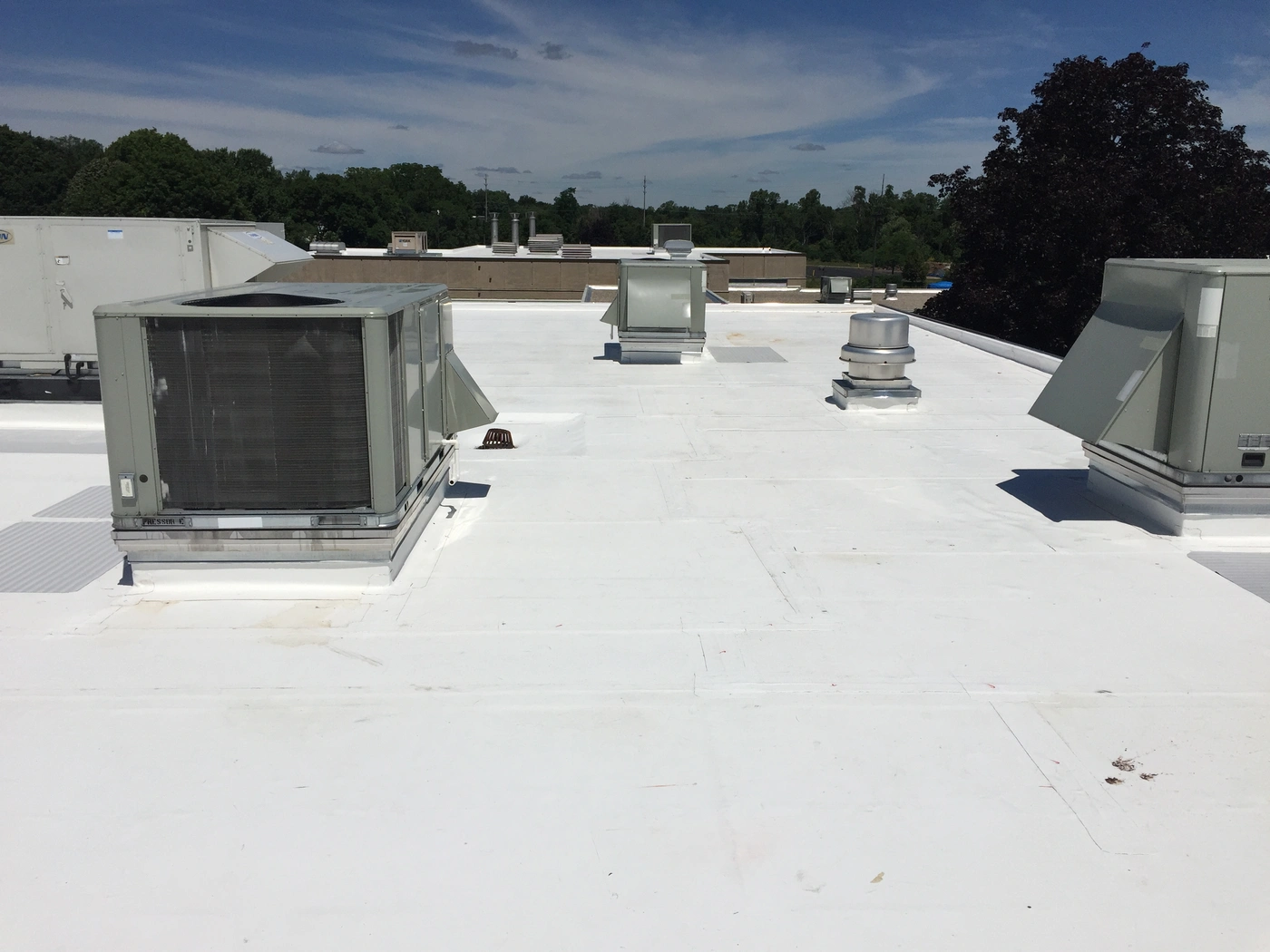
PVC single-ply is the right membrane for Austin restaurants, food service facilities, and buildings with chemical exhaust exposure. SoCo, South Lamar, and the Domain hospitality corridor have exactly the roof environments where PVC's chemical resistance earns its cost premium.
South Congress Avenue and South Lamar Boulevard have the highest concentration of restaurant and food-service tenants on flat-roof buildings in Austin. One- and two-story retail strips from Oltorf Street south to Ben White Boulevard put restaurant exhaust directly onto flat roofs — fryer exhaust, grease-laden vapor, and cleaning chemical discharge from kitchen operations. That exhaust attacks standard TPO and EPDM membranes over time. TPO and EPDM are not designed for sustained grease and chemical exposure; they soften, blister, and ultimately fail at the areas directly under exhaust fans and grease traps.
PVC — polyvinyl chloride single-ply — is the membrane that resists those exposures. PVC's chemical formulation makes it compatible with A properly installed PVC membrane under a restaurant exhaust zone does not blister or soften from grease exposure. This is not a marketing claim; it is a material property that is field-verifiable on any restaurant roof where the membrane type is documented.
The Domain area in northwest Austin adds a different chemical-resistance application: several of the research and tech-adjacent light industrial buildings between Stonelake Boulevard and MoPac have process exhaust or HVAC discharge with chemical content that standard TPO cannot tolerate. For these buildings, PVC is the specification call that avoids early membrane failure in the exhaust impact zone.
PVC Installation for Austin Restaurant and Food-Service Buildings
The installation sequence for PVC on a South Congress or South Lamar restaurant building starts with mapping the exhaust discharge pattern. We document every exhaust fan, grease trap vent, and kitchen discharge point on the roof plan before specification. The membrane layout and flashing details around each discharge point are designed to account for sustained chemical exposure — larger flashing setbacks, chemical-resistant sealant, and in some cases a reinforced PVC membrane grade at the highest-exposure zones.
PVC is heat-weldable like TPO, which produces the same mechanically superior seam bond. Weld parameters for PVC differ from TPO — the membrane's plasticizer content and base chemistry require different temperature and speed calibration. Austin's summer ambient conditions affect PVC weld quality as they affect TPO; we calibrate for current conditions on each production day.
PVC membranes in 50-mil and 60-mil are the standard commercial grades. For restaurant roofs with heavy mechanical traffic — service techs working refrigeration units, exhaust hood maintenance, HVAC service — we specify 60-mil with walk pads at every rooftop access route. Foot traffic without walk pads is the most common cause of premature PVC membrane failure at non-chemical-exposure locations.
PVC Warranty Paths — Up to 25 Years
PVC single-ply carries 15, 20, or 25-year no-dollar-limit warranty options from most major manufacturers — the longest standard commercial membrane warranty available. The 25-year NDL path requires installation to full manufacturer spec, manufacturer field inspection at closeout, and documented annual maintenance. The extended warranty reflects PVC's formulation stability: properly installed PVC membranes retain their chemical resistance and weld integrity well beyond what standard TPO or EPDM warranties cover.
Warranty eligibility for restaurant applications requires specific attention to exhaust flashing details. Most manufacturers require a minimum setback between the membrane edge and any grease discharge point, plus chemical-resistant sealant at all penetrations in the exhaust zone. We build those details into the specification from the start — a restaurant roof that fails warranty inspection because the exhaust flashing did not
We manage the manufacturer warranty closeout the same way on PVC as on TPO: manufacturer field rep walk scheduled as part of the project closeout sequence, not after the building owner has taken possession. The warranty document does not issue until the inspection passes.
PVC vs. TPO for Austin Commercial Restaurants — When to Specify Which
TPO is the right call for most Austin commercial buildings that do not have significant chemical exhaust exposure. PVC's cost premium — typically 15 to 25 percent above comparable TPO per square foot installed — is not justified for a standard office building, retail strip without restaurant tenants, or warehouse. The premium buys chemical resistance that a non-food-service building simply does not need.
PVC is the right call for any building with kitchen exhaust on the roof, any building with chemical process exhaust, and any building where the lease terms or tenant mix makes future food-service occupancy likely. The cost to specify PVC on a speculative mixed-use SoCo building at construction is far lower than retrofitting the exhaust zone flashing detail after a restaurant tenant has been operating for three years and the TPO under the exhaust fans has begun to fail.
For the Domain area buildings with tech or lab tenants: we assess the exhaust chemistry before recommending PVC. Not every lab exhaust is membrane-damaging. If the chemical content of the exhaust is benign, TPO is the correct specification at lower cost. If the exhaust includes solvents, acids, or cleaning chemicals that exceed TPO's chemical tolerance, PVC is the call.
How do I know if my SoCo restaurant building needs PVC instead of TPO?
Look at the membrane around your exhaust fans. If you have TPO and see softening, blistering, or color change in a radius around the exhaust discharge, that is grease and chemical degradation. A membrane that is blistering at the exhaust zone has reduced service life regardless of how the rest of the roof looks. We can assess the extent of the degradation and tell you whether targeted PVC patching at the exhaust zones extends the system or whether the damage pattern warrants a full membrane change.
Can PVC be installed over an existing TPO or EPDM membrane?
Subject to moisture core sampling and manufacturer approval of the specific substrate combination. PVC recover over EPDM requires manufacturer evaluation — some PVC formulations are not compatible with EPDM in direct contact. PVC recover over TPO is generally more straightforward but still requires manufacturer sign-off on the specific product combination. We do not spec a recover without confirming compatibility in writing with the manufacturer before installation.
Does PVC require special cleaning or maintenance compared to TPO?
PVC requires annual inspection consistent with TPO warranty requirements — the difference is that on restaurant roofs, the inspection should specifically document exhaust zone membrane condition and sealant integrity at each discharge point. We include a targeted exhaust-zone check in our PVC maintenance protocol in addition to the standard seam and flashing inspection that applies to any membrane type.
Get a PVC roof system assessment for your Austin restaurant or chemical-exposure building.
If your building has kitchen exhaust, process discharge, or chemical exposure on the roof, let us assess the membrane condition and specify the right system for the actual exposure environment.
- Built Up Roof Systems
- Standing Seam Metal Systems
- Silicone Roof Coating Systems
- Spray Polyurethane Foam Systems
- Cool Roof Systems
- Roof Leak Repair
- School Roofing
- Humidity Damage Roof Repair
Leak points, drainage, seams, penetrations, edge metal, roof access, and interior risk should be clear before the next roof decision is priced.
Immediate repair, maintenance, coating, recover, and replacement choices should be measured against roof age, moisture risk, tenant disruption, and budget timing.
A site visit is useful when the owner needs a documented roof condition, active leak response, storm review, or a clearer capital plan.