
Leak Damage Roof Repair in Austin, TX
- About
- Services
- All Services
- Built-Up Roofing Aust
- Commercial Roof Coatings Aust
- Commercial Roof Condition Reporting Aust
- Commercial Roof Inspections Aust
- Commercial Roof Leak Repair Aust
- Commercial Roof Maintenance Aust
- Commercial Roof Repair Aust
- Commercial Roof Replacement Aust
- Commercial Skylight Repair Aust
- EPDM Roofing Aust
- All Roof Systems
- Ballasted Roof Systems Aust
- Built-Up Roof (BUR) Systems Aust
- Cool Roof Systems Aust
- EPDM Roof Systems Aust
- Modified Bitumen Roof Systems Aust
- PVC Roof Systems Aust
- Silicone Roof Coating Systems Aust
- Spray Polyurethane Foam Roof Systems Aust
- Standing Seam Metal Roof Systems Aust
- TPO Roof Systems Aust
- All Industries
- EV Facility Roofing Aust
- Education Facility Roofing Aust
- Entertainment & Music Venue Roofing Aust
- Financial Services Roofing Aust
- Government Facility Roofing Aust
- Healthcare Roofing Aust
- Hospitality & Hotel Roofing Aust
- Logistics & Distribution Roofing Aust
- Semiconductor & Fab Roofing Aust
- Tech Campus Roofing Aust
- All Damage & Repair
- Fire Damage Roof Repair Aust
- Freeze Damage Roof Repair Aust
- Hail Damage Roof Repair Aust
- Insurance Claim Roof Documentation Aust
- Leak Damage Roof Repair Aust
- Storm Damage Roof Repair Aust
- Structural Roof Damage Assessment Aust
- Tornado Damage Roof Repair Aust
- Water Damage Roof Repair Aust
- Wind Damage Roof Repair Aust
- All Property Types
- Distribution Center Roofing Aust
- Manufacturing Facility Roofing Aust
- Medical Building Roofing Aust
- Multifamily Roofing Aust
- Office Building Roofing Aust
- Religious Building Roofing Aust
- Restaurant Roofing Aust
- Retail Roofing Aust
- School Roofing Aust
- Warehouse Roofing Aust
- All Capabilities
- Commercial Roof Condition Reports Aust
- Commercial Roof Inspections Aust
- Commercial Roof Moisture Surveys Aust
- Commercial Roof Zone Mapping Aust
- Competitive Bid Coordination
- Infrared Roof Scanning Aust
- Manufacturer Warranty Management
- Owner Rep Services — Commercial Roofing Aust
- Replacement vs. Recover Analysis Aust
- Roof Asset Management Aust
Leak source identification and repair on Austin commercial flat roofs — we find the membrane failure point, not just the ceiling stain, and repair it with documentation.
The most common mistake building owners and property managers make with commercial flat roof leaks is assuming the interior water entry point corresponds to the membrane failure point. On a flat commercial roof, water enters the membrane at one location and travels — under the membrane, through saturated insulation, along steel deck, through seams in the deck — before it finds an opening into the building. A ceiling stain on the south side of a building can trace to a drain blockage at the center or a penetration flashing failure on the north side. We locate the membrane failure, not the ceiling stain.
Austin's climate produces leak events across two distinct seasonal patterns. Spring convective events — the Memorial Day 2015 floods dropped over 10 inches in parts of Travis County in less than 24 hours — generate high-volume water entry that overwhelms partially compromised systems. These events produce visible, acute interior flooding. Summer and fall leak events are often chronic and slow: a pinhole in an aged membrane, a hairline crack in penetration sealant, a drain sump that is partially blocked. These events show up as recurring ceiling stains, elevated humidity readings in interior spaces, or — discovered late — structural damage to the deck or interior finishes.
We diagnose commercial roof leaks systematically. The diagnosis drives the repair scope. We do not quote repairs without first walking the roof and identifying the failure mechanism — a drain blockage diagnosis has a different repair than a membrane seam failure diagnosis, and treating the wrong one is waste.
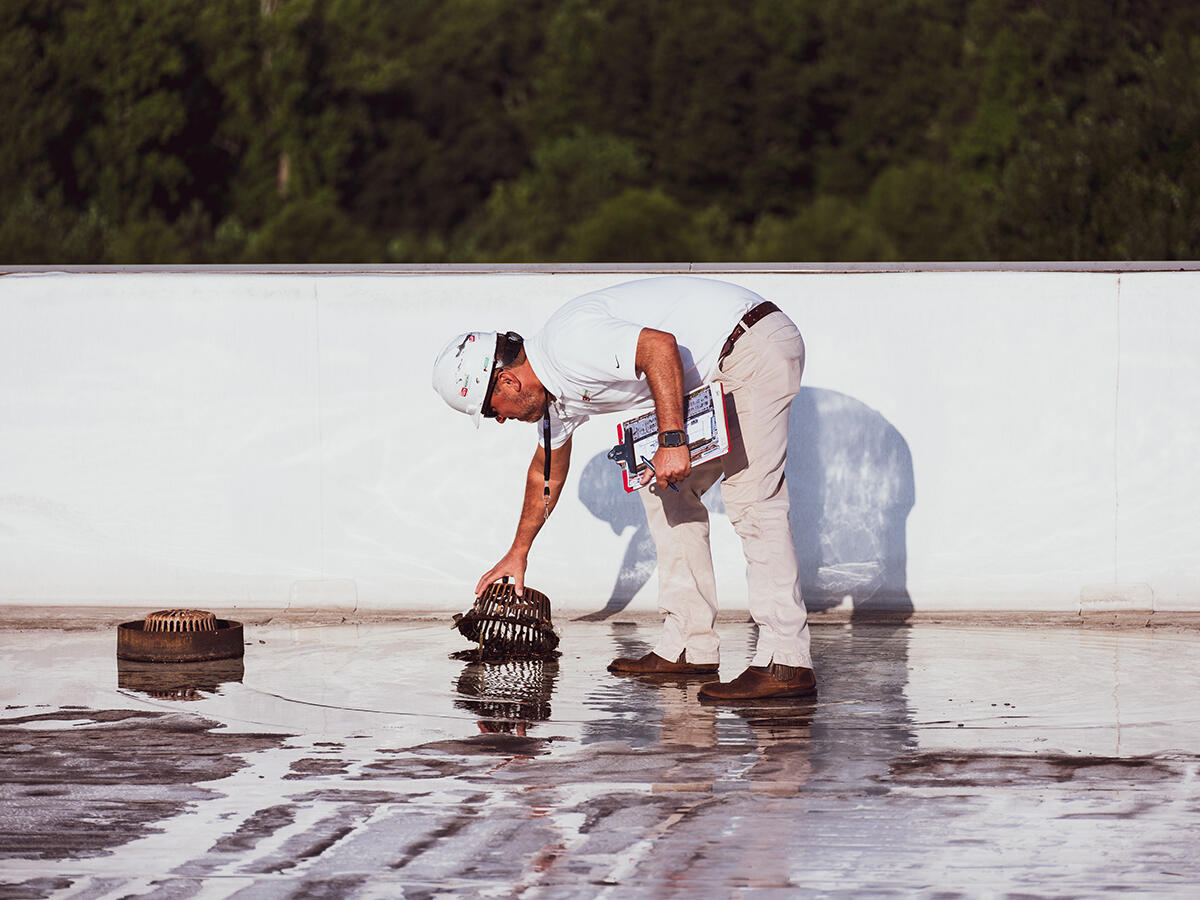
Visual inspection: We walk the full roof surface in a grid pattern, documenting all visible membrane anomalies — blisters, cracks, lifted seams, ponding locations, disturbed sealant at penetrations, and drain sump condition. This is the starting point, not the conclusion.
Infrared thermography: After sunset on a day with significant solar gain, the roof surface cools unevenly — wet insulation retains heat longer than dry insulation. An infrared scan performed after sundown documents the thermal contrast pattern, which maps to wet insulation zones. These zones identify where water has traveled after entering the membrane. We use infrared as a diagnostic tool, not as a marketing claim — the results are documented in the report with a calibrated reference image.
Electronic leak detection (ELD): On roofs with a conductive substrate or a specifically designed ELD-compatible membrane, we can use low-voltage or high-voltage ELD to locate breaches in the membrane without relying on visual inspection alone. This is particularly useful on recently installed membranes where the breach is too small to see but has already produced interior intrusion.
Core sampling for insulation saturation: If infrared or visual inspection suggests saturated insulation, we pull 2-inch diameter cores in the identified wet zones to confirm saturation depth and extent. Core samples also reveal whether the deck below the insulation has corrosion from prolonged moisture exposure.
Common Leak Sources on Austin Commercial Buildings
Drain blockage: Austin's live oak and cedar trees shed debris year-round, and rooftop drain sumps in East Austin and South Congress neighborhoods with significant tree canopy require more frequent clearing than drain sumps on open-lot suburban buildings. A blocked drain that produces standing water above the membrane seam height is the most common chronic leak source we find on Austin mid-city commercial properties.
Penetration flashing failure: HVAC curb flashings, pipe boots, and conduit penetrations are the highest-density failure locations on commercial flat roofs. The sealant at these flashings degrades from Austin's UV exposure and thermal cycling. A pipe boot that sealed correctly at installation may develop a hairline crack that admits water after five to eight years of Austin summer exposure. We re-flash, not re-seal over degraded original flashing.
Seam separation: TPO and EPDM seams that were under-welded or under-bonded at installation may appear intact for years before thermal cycling widens the gap enough to admit water. These failures show up as recurring leaks in the same general area without obvious surface damage. Probe test on the seam confirms whether the weld is sound.
Parapet flashing separation: The roof-to-wall flashing at parapet bases is a high-movement joint — the parapet expands and contracts independently from the roof membrane. On Austin buildings, the temperature differential between a summer morning and afternoon can exceed 80°F, driving significant movement at this joint. Parapet base flashing that was originally adhered to the wall face often separates progressively as the adhesive fatigues.
Every leak repair we perform is documented before, during, and after. Before: the diagnosed failure point with photographs and location on the roof diagram. During: the repair method, materials, and any additional findings uncovered when we opened the membrane for repair. After: the completed repair, including seam probe or flood test result confirming the repair is watertight.
We include a follow-up inspection recommendation in the report for any leak that involved significant insulation saturation. Saturated insulation that is dried in place — rather than replaced — can retain residual moisture that does not show on a post-repair surface inspection. We schedule a re-check at 60 days and include this in the repair closeout package.
Why does my Austin commercial roof keep leaking in the same spot after repairs?
Recurring leaks at the same interior point usually mean the repair addressed a symptom rather than the source. If the actual membrane breach is 20 feet from where previous contractors worked, the water is still entering at the same point and traveling the same path to the same ceiling stain. Our diagnosis starts at the roof surface and works inward — we do not start at the ceiling stain and work outward.
How do I know if a commercial roof leak has damaged the insulation or deck?
Visual inspection of the membrane surface cannot tell you this — insulation saturation and deck corrosion develop beneath the membrane without visible surface evidence. Core sampling and infrared thermography are the tools for this determination. If the leak has been occurring for more than one season, we recommend coring in the affected zone before planning any repair scope.
Does a commercial roof leak void my manufacturer warranty?
Leak investigation and repair performed with compatible materials by a qualified contractor typically does not void an NDL warranty. What can void warranty coverage is performing repairs with incompatible materials — generic sealant over a TPO flashing, for example, when TPO-compatible sealant is required — or failing to notify the manufacturer of a covered repair as required by the warranty terms. We confirm material compatibility and warranty notification requirements before any repair on a system with active warranty coverage.
Schedule a leak diagnosis for your Austin commercial building.
We locate the membrane failure point, not just the interior stain. Written report includes diagnosis, repair scope, and material specification.
- Water Damage Roof Repair
- Fire Damage Roof Repair
- Freeze Damage Roof Repair
- Structural Roof Damage Assessment
- Insurance Claim Roof Documentation
- Retail Roofing
- Emergency Roof Repair
- Built Up Roofing
Leak points, drainage, seams, penetrations, edge metal, roof access, and interior risk should be clear before the next roof decision is priced.
Immediate repair, maintenance, coating, recover, and replacement choices should be measured against roof age, moisture risk, tenant disruption, and budget timing.
A site visit is useful when the owner needs a documented roof condition, active leak response, storm review, or a clearer capital plan.