
Water Damage Roof Repair in Austin, TX
- About
- Services
- All Services
- Built-Up Roofing Aust
- Commercial Roof Coatings Aust
- Commercial Roof Condition Reporting Aust
- Commercial Roof Inspections Aust
- Commercial Roof Leak Repair Aust
- Commercial Roof Maintenance Aust
- Commercial Roof Repair Aust
- Commercial Roof Replacement Aust
- Commercial Skylight Repair Aust
- EPDM Roofing Aust
- All Roof Systems
- Ballasted Roof Systems Aust
- Built-Up Roof (BUR) Systems Aust
- Cool Roof Systems Aust
- EPDM Roof Systems Aust
- Modified Bitumen Roof Systems Aust
- PVC Roof Systems Aust
- Silicone Roof Coating Systems Aust
- Spray Polyurethane Foam Roof Systems Aust
- Standing Seam Metal Roof Systems Aust
- TPO Roof Systems Aust
- All Industries
- EV Facility Roofing Aust
- Education Facility Roofing Aust
- Entertainment & Music Venue Roofing Aust
- Financial Services Roofing Aust
- Government Facility Roofing Aust
- Healthcare Roofing Aust
- Hospitality & Hotel Roofing Aust
- Logistics & Distribution Roofing Aust
- Semiconductor & Fab Roofing Aust
- Tech Campus Roofing Aust
- All Damage & Repair
- Fire Damage Roof Repair Aust
- Freeze Damage Roof Repair Aust
- Hail Damage Roof Repair Aust
- Insurance Claim Roof Documentation Aust
- Leak Damage Roof Repair Aust
- Storm Damage Roof Repair Aust
- Structural Roof Damage Assessment Aust
- Tornado Damage Roof Repair Aust
- Water Damage Roof Repair Aust
- Wind Damage Roof Repair Aust
- All Property Types
- Distribution Center Roofing Aust
- Manufacturing Facility Roofing Aust
- Medical Building Roofing Aust
- Multifamily Roofing Aust
- Office Building Roofing Aust
- Religious Building Roofing Aust
- Restaurant Roofing Aust
- Retail Roofing Aust
- School Roofing Aust
- Warehouse Roofing Aust
- All Capabilities
- Commercial Roof Condition Reports Aust
- Commercial Roof Inspections Aust
- Commercial Roof Moisture Surveys Aust
- Commercial Roof Zone Mapping Aust
- Competitive Bid Coordination
- Infrared Roof Scanning Aust
- Manufacturer Warranty Management
- Owner Rep Services — Commercial Roofing Aust
- Replacement vs. Recover Analysis Aust
- Roof Asset Management Aust
Moisture mapping, insulation saturation assessment, and repair on Austin commercial flat roofs — full documentation of water damage extent before repair scope is set.
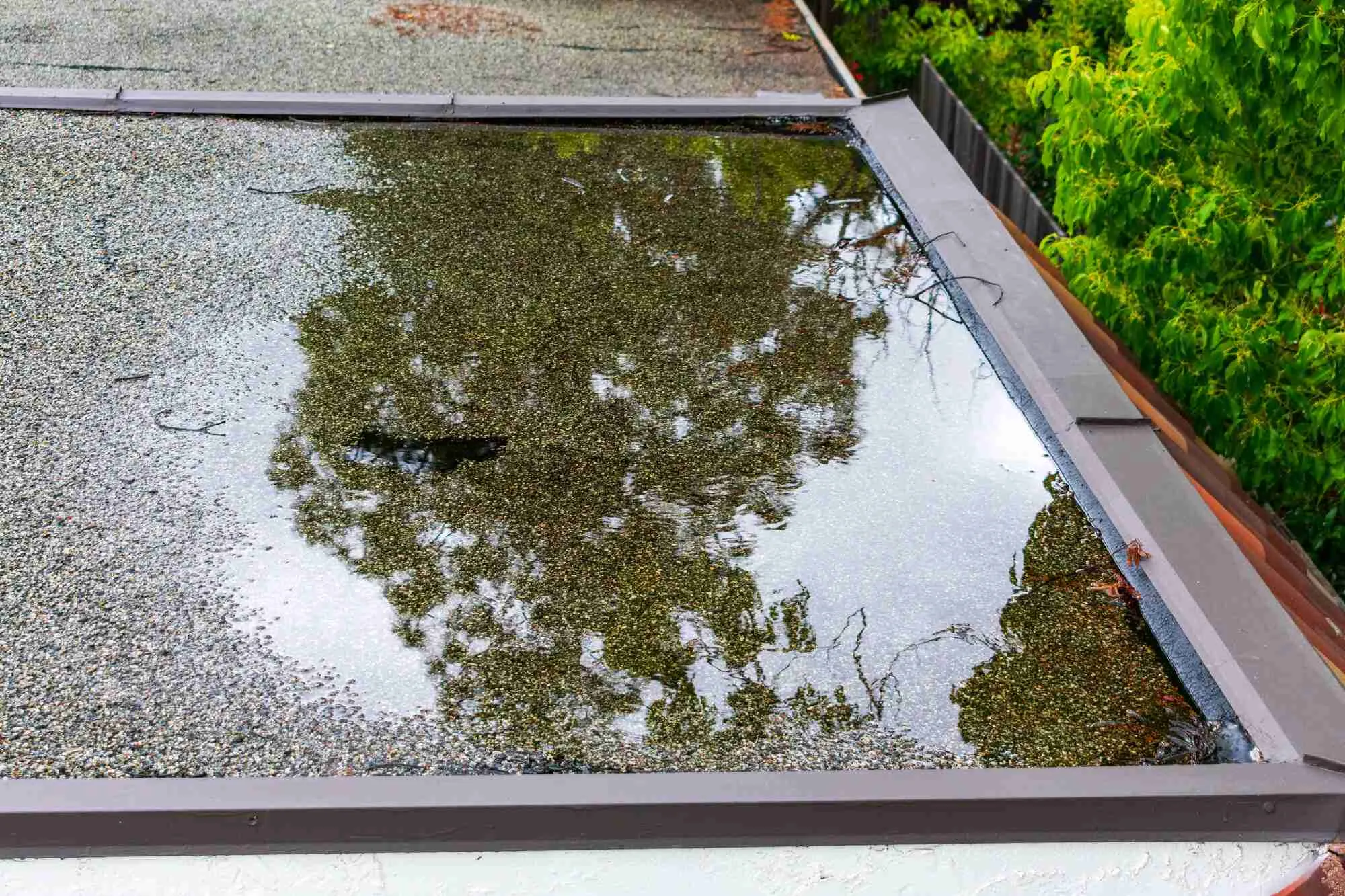
Water damage in commercial roofing has a compounding quality that distinguishes it from most other failure modes. A membrane puncture or seam breach lets water in. The water saturates insulation. Saturated insulation against a steel deck corrodes the deck over time. A corroded steel deck loses pullout resistance for membrane fasteners, making the system vulnerable to wind uplift. If the deck corrosion progresses far enough, the deck itself requires replacement — a cost several times greater than the original membrane repair would have been. This is not a theoretical progression; it is what happens on Austin commercial buildings where a slow leak is ignored for more than one season.
The February 2021 Winter Storm Uri event created a specific and widespread water damage pattern in Austin commercial buildings that was distinct from storm-driven leak events. The freeze-thaw cycling during and after Uri produced pipe failures inside buildings, but it also produced moisture condensation events inside roof assemblies — particularly on buildings with vapor retarder configurations not designed for the sustained sub-freezing conditions that Uri brought. Buildings that had never leaked before showed interior moisture evidence in the months following Uri as trapped condensation moisture migrated through the assembly.
We assess water damage in commercial roof assemblies with the same diagnostic sequence regardless of how the moisture got there. Infrared thermography to map wet zones, core sampling to confirm saturation depth, deck inspection at core locations for corrosion evidence, and a written report that quantifies the affected area before any repair scope is proposed.
Moisture Mapping on Austin Commercial Roofs
Infrared thermography is the non-destructive first pass. We perform the scan after sundown following a day with at least 4 hours of direct solar gain — Austin's sun angle and intensity from March through October provides sufficient thermal loading for most scan days. The scan documents the thermal contrast pattern across the roof surface: wet insulation retains heat longer than dry insulation, producing a warmer thermal signature in wet zones. The IR image is GPS-calibrated and overlaid on the roof zone diagram.
Core sampling confirms what the IR suggests. A 2-inch core pull in each identified wet zone tells us the depth of saturation and whether the insulation is fully saturated or only top-layer wet. Cores pulled at deck level confirm whether the moisture has reached the steel and whether corrosion is present.
Wet zone quantification: We calculate the total wet area as a percentage of roof surface based on IR scan and core confirmation data. This percentage drives the recover-versus-replace recommendation: under 25% wet insulation can often be addressed by targeted replacement of wet sections and recovery of the dry areas. Above 25%, full replacement is typically the economically sound scope — recovering over extensive wet insulation voids the new warranty and produces premature failure.
Deck Condition Assessment in Water-Damaged Assemblies
Steel deck corrosion in Austin commercial buildings follows predictable patterns. The fastener field points — where membrane and insulation fasteners penetrate the deck — are the highest-stress corrosion initiation points. If moisture has been present in the assembly for more than one season, we expect to find surface rust at fastener penetrations. If the moisture has been present for multiple years, we may find section loss in the deck at the worst points.
Pullout resistance testing: On decks with suspected corrosion, we perform fastener pullout tests at representative locations to confirm whether the deck gauge can still hold fasteners at the required design uplift load. A deck that fails pullout testing at the required load requires either reinforcement or replacement before a new membrane system can be installed with warranty-compliant fastener patterns.
Corrosion documentation for capital planning: Even where the deck is still structurally serviceable, we document corrosion extent and location in the written report. A deck with 10% section loss at fastener points is not an immediate replacement, but the facility manager should know it exists when planning the next major capital cycle.
Water Damage Repair Scope Options
Targeted insulation replacement with membrane recover: For buildings with under 25% wet insulation confirmed by core sampling, we cut and remove wet insulation sections, install new insulation at equivalent R-value and fastener pattern, and recover the entire roof with new membrane. This scope treats the insulation problem without the full tear-off cost.
Full replacement: For buildings over 25% wet insulation saturation, or where deck corrosion is extensive, full tear-off and replacement is the appropriate scope. We include deck repair or replacement as a separate line item if the deck assessment indicates it is required.
Fluid-applied restoration with dry-zone limitation: On roofs where the wet zone is under 10% and confined to an identifiable section, a fluid-applied silicone or acrylic coating system can extend the life of the dry membrane zones while targeted insulation replacement addresses the wet areas. This is a 10-to-15-year solution, not a permanent fix — it is appropriate for buildings with a defined capital horizon that makes full replacement premature.
How can I tell if water damage has reached the structural deck on my Austin commercial building?
Surface inspection of the membrane cannot determine deck condition. Core sampling at suspect wet zones and pullout testing at the core locations are the standard methods. If the building had a long-term chronic leak — more than two seasons without repair — we recommend core sampling even if the IR scan does not show extensive wet zone, because slow chronic leaks can produce localized deck corrosion that does not have a large thermal signature.
What happened to Austin commercial roofs during Winter Storm Uri in February 2021?
Uri produced two distinct damage mechanisms: immediate freeze damage to exposed rooftop plumbing and membrane (covered under the freeze-damage category), and a slower condensation-related moisture event inside assemblies not designed for sustained sub-freezing exposure. Buildings with vapor retarder configurations calibrated to Austin's typical climate — cooling-dominant, not heating-dominant — saw interior condensation events in the months following Uri as the assembly temperature normalized. If your building showed new moisture evidence in spring 2021 without a corresponding storm event, a Uri-related condensation assessment is worth having.
Does water-damaged insulation need to be replaced, or can it dry out in place?
In a closed roofing assembly — insulation trapped between the deck and the membrane — the insulation cannot dry out in any meaningful timeframe without being exposed. The assembly has no air movement, and moisture evaporation requires air circulation. Saturated polyiso insulation in a closed assembly will remain saturated until it is removed. There is no drying-out-in-place scenario for commercial roofing insulation.
Get a moisture mapping assessment for your Austin commercial building.
IR scan, core sampling, and deck assessment delivered in a single written report. We quantify the wet zone before we propose any repair scope.
- Fire Damage Roof Repair
- Freeze Damage Roof Repair
- Structural Roof Damage Assessment
- Insurance Claim Roof Documentation
- Hail Damage Roof Repair
- Hotel Roofing
- Commercial Roof Coatings
- Silicone Roof Coating
Leak points, drainage, seams, penetrations, edge metal, roof access, and interior risk should be clear before the next roof decision is priced.
Immediate repair, maintenance, coating, recover, and replacement choices should be measured against roof age, moisture risk, tenant disruption, and budget timing.
A site visit is useful when the owner needs a documented roof condition, active leak response, storm review, or a clearer capital plan.