
Silicone Roof Coating Systems in Austin, TX
- About
- Services
- All Services
- Built-Up Roofing Aust
- Commercial Roof Coatings Aust
- Commercial Roof Condition Reporting Aust
- Commercial Roof Inspections Aust
- Commercial Roof Leak Repair Aust
- Commercial Roof Maintenance Aust
- Commercial Roof Repair Aust
- Commercial Roof Replacement Aust
- Commercial Skylight Repair Aust
- EPDM Roofing Aust
- All Roof Systems
- Ballasted Roof Systems Aust
- Built-Up Roof (BUR) Systems Aust
- Cool Roof Systems Aust
- EPDM Roof Systems Aust
- Modified Bitumen Roof Systems Aust
- PVC Roof Systems Aust
- Silicone Roof Coating Systems Aust
- Spray Polyurethane Foam Roof Systems Aust
- Standing Seam Metal Roof Systems Aust
- TPO Roof Systems Aust
- All Industries
- EV Facility Roofing Aust
- Education Facility Roofing Aust
- Entertainment & Music Venue Roofing Aust
- Financial Services Roofing Aust
- Government Facility Roofing Aust
- Healthcare Roofing Aust
- Hospitality & Hotel Roofing Aust
- Logistics & Distribution Roofing Aust
- Semiconductor & Fab Roofing Aust
- Tech Campus Roofing Aust
- All Damage & Repair
- Fire Damage Roof Repair Aust
- Freeze Damage Roof Repair Aust
- Hail Damage Roof Repair Aust
- Insurance Claim Roof Documentation Aust
- Leak Damage Roof Repair Aust
- Storm Damage Roof Repair Aust
- Structural Roof Damage Assessment Aust
- Tornado Damage Roof Repair Aust
- Water Damage Roof Repair Aust
- Wind Damage Roof Repair Aust
- All Property Types
- Distribution Center Roofing Aust
- Manufacturing Facility Roofing Aust
- Medical Building Roofing Aust
- Multifamily Roofing Aust
- Office Building Roofing Aust
- Religious Building Roofing Aust
- Restaurant Roofing Aust
- Retail Roofing Aust
- School Roofing Aust
- Warehouse Roofing Aust
- All Capabilities
- Commercial Roof Condition Reports Aust
- Commercial Roof Inspections Aust
- Commercial Roof Moisture Surveys Aust
- Commercial Roof Zone Mapping Aust
- Competitive Bid Coordination
- Infrared Roof Scanning Aust
- Manufacturer Warranty Management
- Owner Rep Services — Commercial Roofing Aust
- Replacement vs. Recover Analysis Aust
- Roof Asset Management Aust
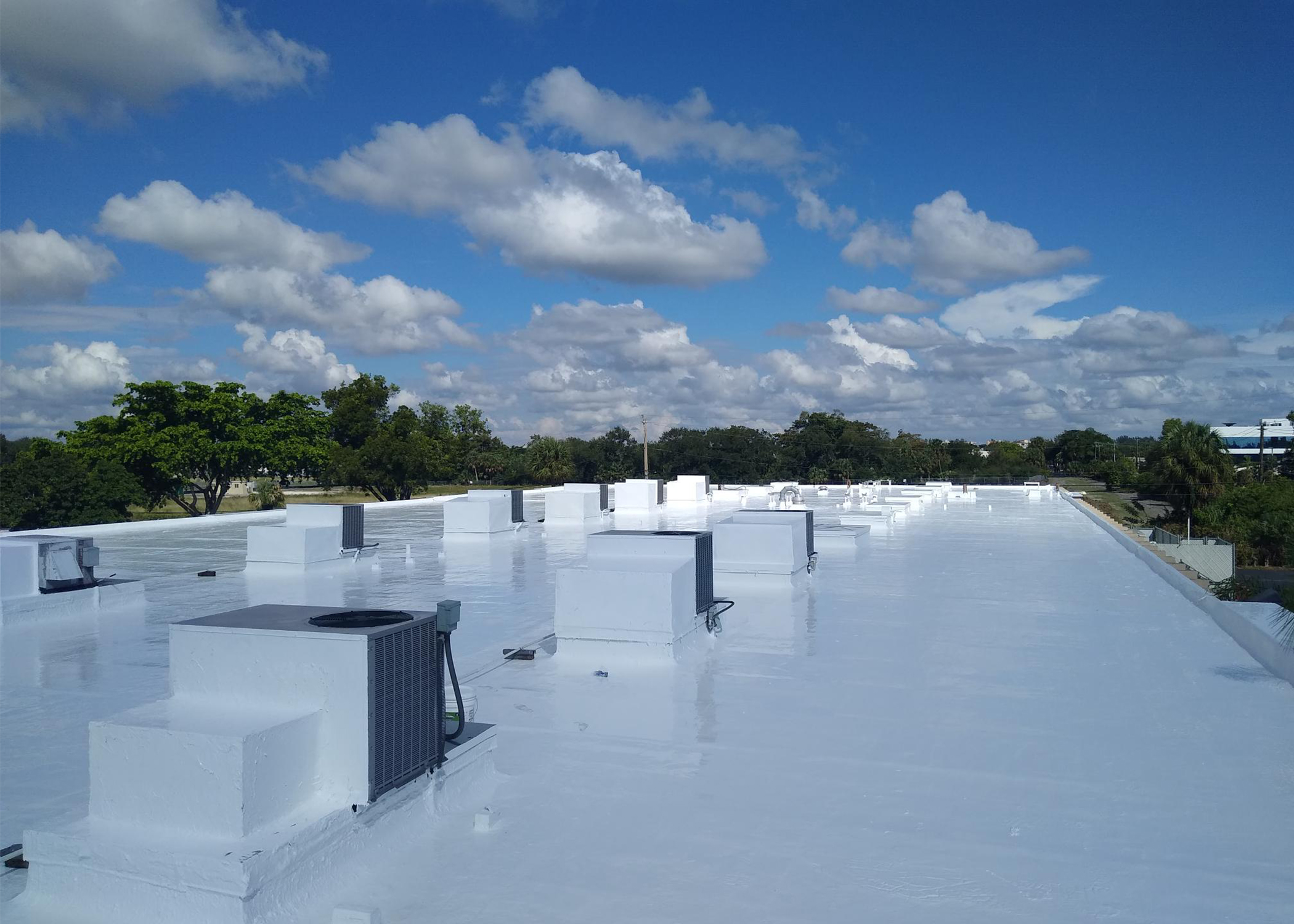
Fluid-applied silicone coating is the recover specification for Austin commercial buildings with sound-but-aging TPO, EPDM, or modified bitumen substrates. Austin's UV intensity makes reflectivity restoration a meaningful operating cost benefit — and silicone's ponding-water resistance is unmatched among coating types.
Austin averages over 300 days of measurable sunshine per year. The UV index on a peak summer day in Central Texas is among the highest in the continental United States. A white commercial roof membrane at year one reflects 80 to 90 percent of that radiation. At year 12 to 15 on a typical TPO or EPDM system, surface oxidation and soiling have reduced that reflectance significantly — the membrane is doing less work for the building's cooling system than it was at installation.
Fluid-applied silicone coating restores reflectance to near-new levels on eligible substrates without the cost and disruption of membrane replacement. A properly prepared and applied silicone coating system on a 60-mil TPO roof adds 10 to 15 years of service life, renews the roof's reflective performance, and carries a manufacturer warranty in 10, 15, or 20-year increments depending on applied thickness. For Austin building owners managing commercial property through a 5 to 10 year hold period, silicone coating frequently produces better IRR than full membrane replacement.
Silicone's defining advantage over acrylic and urethane coatings is ponding-water resistance. Silicone does not re-emulsify or degrade in standing water — it remains elastomeric and watertight even if water ponds on the coated surface for extended periods. Austin's flat commercial roofs, especially those with blocked drains or inadequate slope, pond after rain events. Acrylic coatings in ponding conditions soften and eventually delaminate; silicone does not. For Austin commercial buildings where drain maintenance is inconsistent or the drainage geometry creates chronic ponding zones, silicone is the correct coating specification.
Substrate Eligibility and Pre-Coating Assessment
Silicone coating is not appropriate for every Austin commercial roof that inquires about it. The substrate must We assess coating eligibility with a roof walk, moisture core sampling at suspect locations, and adhesion testing of the coating product to the specific substrate.
Moisture cores are the first gate. If insulation saturation covers more than 10 percent of the sampled area, coating over the saturated zone traps moisture and accelerates deck deterioration — the coating looks good on the surface while the assembly fails beneath it. Saturated areas require targeted insulation replacement before the coating goes on; extensive saturation means full replacement is the right scope and coating is not in the picture.
Substrate adhesion testing is the second gate. Silicone adheres differently to new versus UV-oxidized TPO, clean versus oil-contaminated EPDM, and granule-surfaced versus smooth mod-bit. We test adhesion on a representative sample of the substrate before specifying a coating product. If adhesion test results are below the manufacturer's minimum, we determine whether a primer resolves it or whether the substrate condition disqualifies the coating approach entirely.
Silicone Application and Austin UV Conditions
Silicone coating is applied in one or two coats to achieve the specified total dry film thickness — typically 20 to 30 mils for a 10-year warranty and 30 to 40 mils for a 20-year warranty. The total applied thickness determines both the warranty length and the ponding-water resistance of the finished system.
Application timing in Austin requires attention to surface temperature and ambient humidity. Silicone applied to a substrate above 180°F surface temperature can bubble — which occurs on dark EPDM or aged TPO on a peak August afternoon in Austin. We schedule application for morning hours when substrate temperature is below the safe application threshold, or shade the work area on smaller applications where this is practical.
Austin's summer UV intensity accelerates silicone cure. This is generally favorable — fully cured silicone is rain-resistant and the fast cure reduces the window during which an unscheduled afternoon thunderstorm can damage the uncured coat. We track morning weather and have a firm no-application rule if afternoon storm probability exceeds 40 percent during the cure window.
Silicone Coating Warranties and Long-Term Economics for Austin Buildings
A 10-year silicone coating warranty from a major manufacturer on a properly prepared substrate typically costs 35 to 55 percent of a full membrane replacement on the same building. A 20-year warranty coating system — higher applied thickness, more stringent substrate prep — costs 55 to 70 percent of replacement. For a building owner facing a 10-year hold, the coating path often generates better capital efficiency than replacement, assuming the substrate genuinely qualifies.
The key word is genuinely. A coating that is applied over a marginally eligible substrate because the building owner prefers the lower upfront cost will fail before the warranty term and leave the building owner with a warranty claim dispute and a roof that still needs replacement. We do not recommend coating as a cost-reduction shortcut on substrates that do not
At the end of a silicone coating warranty term, the building has three paths: re-coat with an additional silicone layer to extend the system further (possible on most substrates if condition is good), recover with a new membrane, or full replacement. Austin building owners managing multi-building portfolios often find that staggering coating renewal across their buildings smooths capital expenditure compared to the lumpy cost of full replacements sequenced by membrane age.
How much does silicone roof coating reduce cooling costs in Austin?
A white silicone coating restoring reflectance to 85 to 90 percent on an aged commercial roof can reduce rooftop surface temperature by 30 to 50°F compared to the pre-coating oxidized membrane. The cooling-load reduction for the building below depends on insulation thickness and HVAC system design — a well-insulated roof transmits less heat regardless of membrane color. For Austin buildings with minimal insulation in the legacy assembly, the cooling-cost reduction from restored reflectance is more pronounced. We do not promise specific dollar savings figures; the variables are too building-specific.
Can silicone coating be applied over a granule-surfaced modified bitumen roof?
Yes, with granule preparation. Silicone does not adhere well to aggregate or granules — the granule layer must be embedded and primed before the coating goes on. We apply a granule-saturating primer at the appropriate mil thickness to encapsulate the granules, verify adhesion by pull test, and then apply the silicone topcoat. Granule-surfaced BUR requires similar preparation. The preparation step adds labor and material cost relative to smooth membrane substrates.
Does silicone coating prevent hail damage?
Silicone coating adds modest impact resistance at the membrane surface but does not meaningfully protect against hail damage from the quarter-size and larger stones documented in Austin-area storm events. A silicone-coated membrane is not a hail-resistant specification. If your building is in a documented hail-corridor location and impact resistance is the primary concern, membrane upgrade to 80-mil TPO is the correct specification, not coating.
Find out if your Austin commercial roof qualifies for silicone coating.
We assess the substrate, pull cores, test adhesion, and give you an honest answer about whether coating produces better economics than replacement for your specific building and hold period.
- Cool Roof Systems
- Ballasted Roof Systems
- TPO Roof Systems
- EPDM Roof Systems
- PVC Roof Systems
- Expansion Joint Repair
- Office Building Roofing
- Storm Damage Roof Repair
Leak points, drainage, seams, penetrations, edge metal, roof access, and interior risk should be clear before the next roof decision is priced.
Immediate repair, maintenance, coating, recover, and replacement choices should be measured against roof age, moisture risk, tenant disruption, and budget timing.
A site visit is useful when the owner needs a documented roof condition, active leak response, storm review, or a clearer capital plan.