
Emergency Roof Repair in Austin, TX
- About
- Services
- All Services
- Built-Up Roofing Aust
- Commercial Roof Coatings Aust
- Commercial Roof Condition Reporting Aust
- Commercial Roof Inspections Aust
- Commercial Roof Leak Repair Aust
- Commercial Roof Maintenance Aust
- Commercial Roof Repair Aust
- Commercial Roof Replacement Aust
- Commercial Skylight Repair Aust
- EPDM Roofing Aust
- All Roof Systems
- Ballasted Roof Systems Aust
- Built-Up Roof (BUR) Systems Aust
- Cool Roof Systems Aust
- EPDM Roof Systems Aust
- Modified Bitumen Roof Systems Aust
- PVC Roof Systems Aust
- Silicone Roof Coating Systems Aust
- Spray Polyurethane Foam Roof Systems Aust
- Standing Seam Metal Roof Systems Aust
- TPO Roof Systems Aust
- All Industries
- EV Facility Roofing Aust
- Education Facility Roofing Aust
- Entertainment & Music Venue Roofing Aust
- Financial Services Roofing Aust
- Government Facility Roofing Aust
- Healthcare Roofing Aust
- Hospitality & Hotel Roofing Aust
- Logistics & Distribution Roofing Aust
- Semiconductor & Fab Roofing Aust
- Tech Campus Roofing Aust
- All Damage & Repair
- Fire Damage Roof Repair Aust
- Freeze Damage Roof Repair Aust
- Hail Damage Roof Repair Aust
- Insurance Claim Roof Documentation Aust
- Leak Damage Roof Repair Aust
- Storm Damage Roof Repair Aust
- Structural Roof Damage Assessment Aust
- Tornado Damage Roof Repair Aust
- Water Damage Roof Repair Aust
- Wind Damage Roof Repair Aust
- All Property Types
- Distribution Center Roofing Aust
- Manufacturing Facility Roofing Aust
- Medical Building Roofing Aust
- Multifamily Roofing Aust
- Office Building Roofing Aust
- Religious Building Roofing Aust
- Restaurant Roofing Aust
- Retail Roofing Aust
- School Roofing Aust
- Warehouse Roofing Aust
- All Capabilities
- Commercial Roof Condition Reports Aust
- Commercial Roof Inspections Aust
- Commercial Roof Moisture Surveys Aust
- Commercial Roof Zone Mapping Aust
- Competitive Bid Coordination
- Infrared Roof Scanning Aust
- Manufacturer Warranty Management
- Owner Rep Services — Commercial Roofing Aust
- Replacement vs. Recover Analysis Aust
- Roof Asset Management Aust
Same-day dry-in and active-leak response for Austin commercial buildings — after hail, convective storm events, or sudden membrane failure. We stage emergency materials to reach inner-city buildings within four hours of authorization.
Austin's storm profile has established a documented baseline for what Central Texas convective events can do to a commercial flat roof in a matter of hours. The Halloween 2013 flood dropped 7-plus inches across Travis County in a single event. The Memorial Day 2015 flood followed 18 months later with a comparable rainfall rate on terrain that was already saturated. In June 2024, quarter-size hail swept Round Rock and Pflugerville in a storm that generated a run of insurance claims across Williamson County. None of these events gave building owners advance warning measured in days — response time measured in hours is what determines whether interior damage is a modest repair or a multi-tenant catastrophe.
We keep emergency dry-in materials — polyethylene tarping in commercial widths, batten systems, adhesive membrane patches, and temporary drain covers — staged so we can load and mobilize without waiting for a supply run. When you call with an active leak on a 78701 or 78702 building, our crews are on-site within four hours of confirmed authorization during business hours, and we return calls on emergency lines after hours.
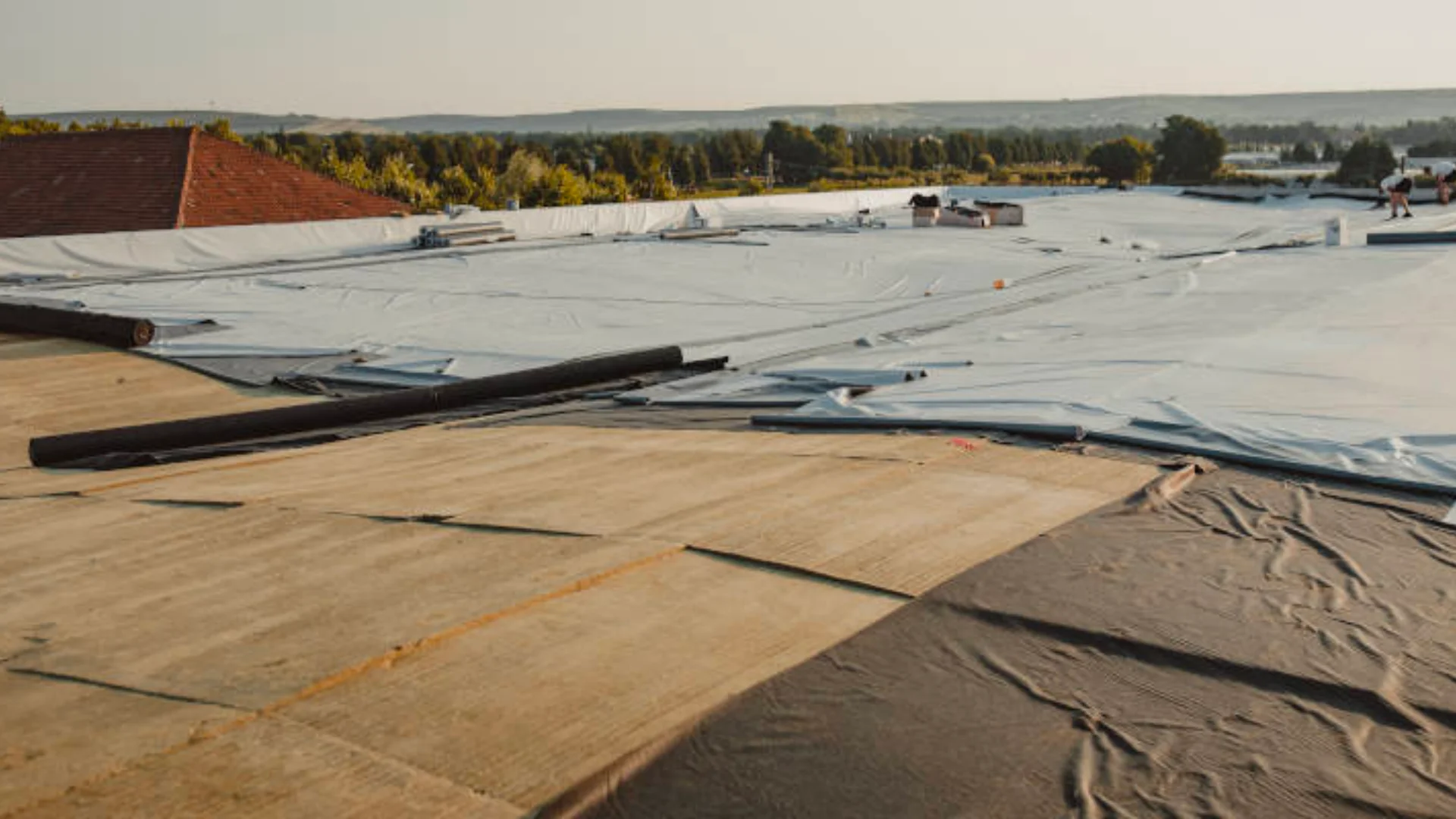
The objective of an emergency response is to stop water from entering the building and to document the failure for the insurance or warranty process that follows. We photograph every damaged zone, install temporary protection in a way that allows subsequent permanent repair without disturbing the documentation, and provide a written field report the same day.
Storm Scenarios We Respond To in Austin
Hail impact on membrane and flashing: Quarter-size and larger hailstones impact flat TPO and EPDM membranes at sufficient force to produce surface bruising, insulation compression, and — on membranes with UV degradation or previous impact history — punctures. Hail impact on metal HVAC curbs and parapet coping can displace flashing material and create immediate water entry points. After a documented hail event — like the June 2024 Round Rock storm — we assess impact severity by zone, differentiate cosmetic denting from penetrating breach, and document with GPS-located photographs for the insurance record.
Convective storm membrane failure: High-wind gusts associated with Central Texas convective cells can partially lift membrane at improperly fastened seam edges, at parapet perimeter termination bars, and at rooftop equipment curb flashings. A partially lifted edge in an active storm becomes a full breach within minutes. Emergency response on wind-damaged roofs involves temporary mechanical re-fastening of lifted membrane sections and adhesive sealing of exposed insulation before the next rain event.
Drain blockage and acute ponding: Austin's late spring and early fall storm seasons produce rainfall rates that overwhelm clogged or undersized drain systems. Ponding more than 2 inches deep on a flat commercial roof for more than 48 hours — the standard building code ponding limitation threshold — creates hydrostatic pressure that pushes water through aging seams and flashings that would otherwise hold. Emergency drain clearing is often the first respons on buildings in the East Austin warehouse corridor and the industrial areas near Austin-Bergstrom International Airport.
Our Emergency Response Protocol
First contact through dispatch: We maintain an emergency line answered during business hours and monitored after hours. When you call with an active leak, we ask for building location, approximate affected area, membrane system if known, and whether interior access is needed to assess water entry. We confirm crew availability and authorization before committing a response time.
On-site assessment and immediate dry-in: The crew lead walks the roof surface to locate breach points while interior assessment is made if access is available. Temporary dry-in goes in as soon as the breach location is confirmed — we do not wait to complete the full condition assessment before stopping water entry. Tarps are ballasted or mechanically anchored to prevent wind displacement; we do not rely on sandbag perimeters alone on Austin roofs where afternoon winds can exceed 30 mph during convective weather.
Documentation and written field report: Every damaged zone is photographed before temporary protection is installed and after. The field report delivered the same day includes breach location with roof zone identifier, estimated affected membrane area, temporary repair method and materials used, and a preliminary scope note for the permanent repair. This documentation is structured for insurance adjuster use — we provide it at no additional charge as part of the emergency response.
From Emergency Dry-In to Permanent Repair
Temporary dry-in is not a permanent fix. We follow every emergency response with a scheduled permanent repair scope within 5 to 10 business days of the initial event, weather and production schedule permitting. The permanent repair is scoped against the full documented damage — not just the breach point we addressed in the emergency response — and is priced as a separate authorization.
For buildings where the storm damage is extensive enough to involve a manufacturer warranty claim or a property insurance claim, we coordinate the permanent repair scope with the adjuster's inspection schedule. This matters for Domain and Stonelake campus buildings where institutional property management requires insurer sign-off before permanent repair authorization. We do not pressure building owners to authorize permanent repair before their insurance process is complete — the temporary dry-in holds until the claim process concludes.
The Samsung semiconductor fabrication plant in Taylor and the Tesla Gigafactory Texas site in Del Valle are large-format industrial facilities in the greater Austin MSA with zero-tolerance interior environments. Emergency response for similar large-format industrial clients in Travis and Williamson counties is sequenced to protect sensitive interior areas first — server rooms, clean rooms, and sensitive storage — before completing the broader roof assessment.
How quickly can you respond to an emergency roof leak in Austin?
Inner-city Austin properties — downtown, East Austin, South Congress, Mueller, Domain — get crews on-site within four business hours of confirmed authorization. Round Rock, Pflugerville, and Del Valle properties are within same-day reach during business hours. We maintain emergency materials staged for immediate load-out.
What does an emergency dry-in cost?
Emergency dry-in is priced by crew time and materials used. We provide a written estimate before dispatch when the scope can be described over the phone; for complex or multi-zone damage, the estimate is delivered after the initial on-site assessment. Emergency response calls are not open-ended — we confirm the scope and cost before proceeding.
Will the emergency repair affect my insurance claim?
Emergency dry-in to stop active water intrusion is universally encouraged by property insurers — failing to mitigate further damage can reduce a claim. We document the pre-repair damage condition before installing any temporary protection. Our field report is structured for adjuster use. If your insurer requires a pre-repair inspection before any work, let us know — we can hold temporary tarping above the breach without sealing it until the adjuster has seen the damage condition.
Active leak on your Austin commercial roof? Call now.
We respond to inner-city Austin properties within four hours. Tell us the building location and what you are seeing — we will confirm availability and dispatch.
- Roof Recover Systems
- Manufacturing Facility Roofing
- Government Building Roofing
- Preventive Roof Maintenance
- Modified Bitumen Roofing
- Roof Asset Management Program
- EPDM Roofing
- About
Leak points, drainage, seams, penetrations, edge metal, roof access, and interior risk should be clear before the next roof decision is priced.
Immediate repair, maintenance, coating, recover, and replacement choices should be measured against roof age, moisture risk, tenant disruption, and budget timing.
A site visit is useful when the owner needs a documented roof condition, active leak response, storm review, or a clearer capital plan.