
Modified Bitumen Roofing in Austin, TX
- About
- Services
- All Services
- Built-Up Roofing Aust
- Commercial Roof Coatings Aust
- Commercial Roof Condition Reporting Aust
- Commercial Roof Inspections Aust
- Commercial Roof Leak Repair Aust
- Commercial Roof Maintenance Aust
- Commercial Roof Repair Aust
- Commercial Roof Replacement Aust
- Commercial Skylight Repair Aust
- EPDM Roofing Aust
- All Roof Systems
- Ballasted Roof Systems Aust
- Built-Up Roof (BUR) Systems Aust
- Cool Roof Systems Aust
- EPDM Roof Systems Aust
- Modified Bitumen Roof Systems Aust
- PVC Roof Systems Aust
- Silicone Roof Coating Systems Aust
- Spray Polyurethane Foam Roof Systems Aust
- Standing Seam Metal Roof Systems Aust
- TPO Roof Systems Aust
- All Industries
- EV Facility Roofing Aust
- Education Facility Roofing Aust
- Entertainment & Music Venue Roofing Aust
- Financial Services Roofing Aust
- Government Facility Roofing Aust
- Healthcare Roofing Aust
- Hospitality & Hotel Roofing Aust
- Logistics & Distribution Roofing Aust
- Semiconductor & Fab Roofing Aust
- Tech Campus Roofing Aust
- All Damage & Repair
- Fire Damage Roof Repair Aust
- Freeze Damage Roof Repair Aust
- Hail Damage Roof Repair Aust
- Insurance Claim Roof Documentation Aust
- Leak Damage Roof Repair Aust
- Storm Damage Roof Repair Aust
- Structural Roof Damage Assessment Aust
- Tornado Damage Roof Repair Aust
- Water Damage Roof Repair Aust
- Wind Damage Roof Repair Aust
- All Property Types
- Distribution Center Roofing Aust
- Manufacturing Facility Roofing Aust
- Medical Building Roofing Aust
- Multifamily Roofing Aust
- Office Building Roofing Aust
- Religious Building Roofing Aust
- Restaurant Roofing Aust
- Retail Roofing Aust
- School Roofing Aust
- Warehouse Roofing Aust
- All Capabilities
- Commercial Roof Condition Reports Aust
- Commercial Roof Inspections Aust
- Commercial Roof Moisture Surveys Aust
- Commercial Roof Zone Mapping Aust
- Competitive Bid Coordination
- Infrared Roof Scanning Aust
- Manufacturer Warranty Management
- Owner Rep Services — Commercial Roofing Aust
- Replacement vs. Recover Analysis Aust
- Roof Asset Management Aust
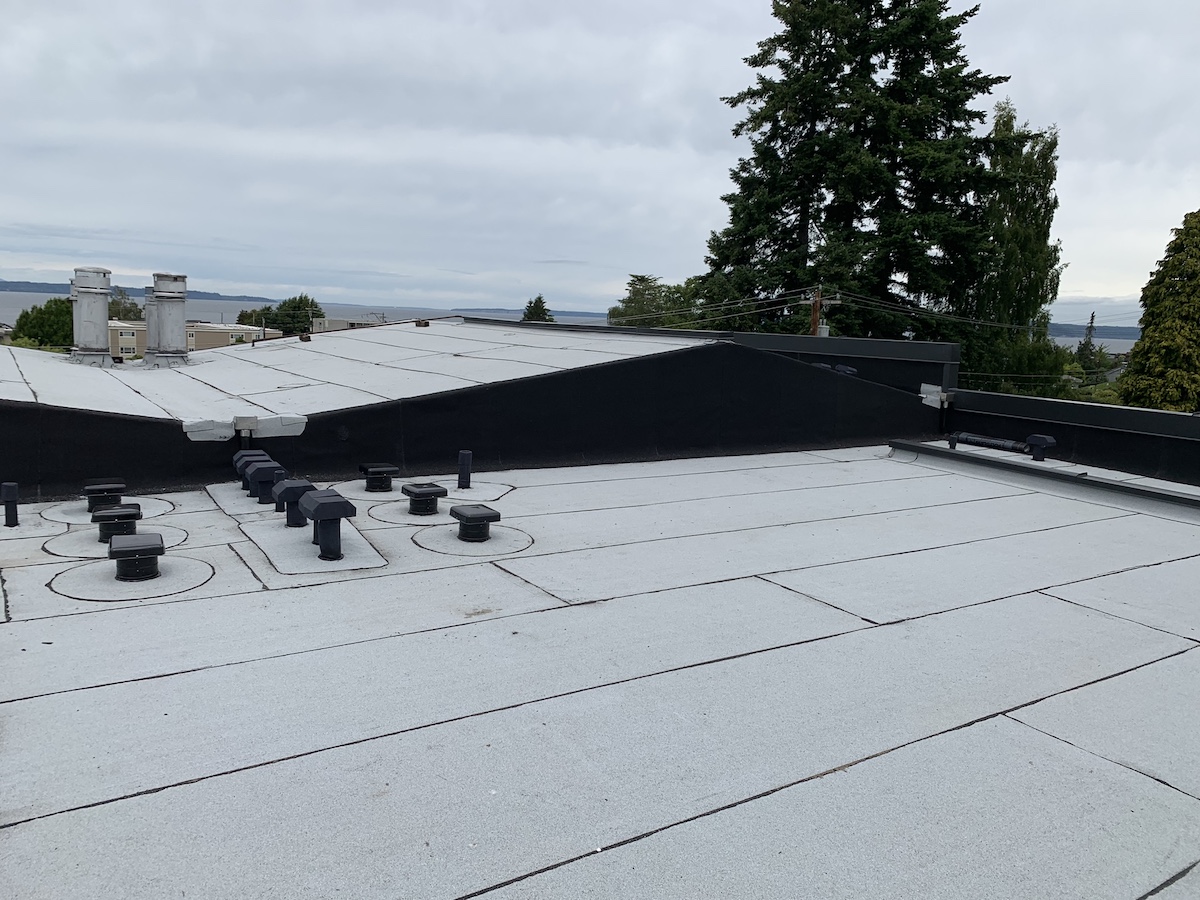
Modified bitumen roofing for Austin commercial buildings — torch-applied SBS and APP systems for new installation, recover over BUR, and repair on aging multi-ply roofs. Durable, field-confirmed systems for the Central Texas climate.
Modified bitumen is not a legacy system — it is the right system for a specific category of Austin commercial building. While TPO has become the dominant single-ply choice for new commercial flat roofs across the Austin metro, modified bitumen remains the appropriate specification for built-up roof recovers, for buildings with complex geometric detail where a torched-in or cold-applied multi-ply system provides better flashing integration, and for owners who prioritize puncture resistance and field repairability over reflectivity and energy code metrics.
Austin's existing commercial inventory includes a significant number of pre-2000 built-up roofing systems — coal tar pitch and gravel, asphalt and aggregate — particularly in the older industrial corridor east of I-35, in the East Austin warehouse district near Airport Boulevard, and in the medical campus buildings in the Seton/Dell Medical District. These older BUR systems are appropriate recover candidates for modified bitumen when insulation is dry and deck is sound. A modified bitumen recover over a dry BUR system can add 15 to 20 years of service life at significantly lower cost than full tear-off and replacement.
We install SBS (styrene-butadiene-styrene) and APP (atactic polypropylene) modified bitumen systems on Austin commercial buildings. The distinction matters in Central Texas: APP systems use torch-applied installation that produces high seam security in Austin's heat but requires experienced torch operators — improperly torched APP is a fire hazard on any roof with combustible substrate material. SBS systems can be cold-applied or heat-welded, and their low-temperature flexibility gives better performance in Austin's winter freeze events, which, while infrequent, have produced flashing failures on older torch-applied systems during events like the February 2021 freeze.
SBS vs. APP for Austin's Climate
SBS-modified bitumen is the more flexible of the two at low temperature. Austin's winter temperature range extends to the low 20s°F during hard freeze events — rare, but documented. SBS membrane maintains elasticity at those temperatures where APP becomes brittle and is more susceptible to crack initiation at seams and flashings. For Austin commercial buildings where winter freeze exposure is a design consideration, SBS is the more conservative specification.
APP-modified bitumen is more resistant to UV degradation and has a higher softening point than SBS — meaningful on Austin roofs where summer surface temperatures regularly exceed 150°F. An APP cap sheet in the granulated form (with mineral surface granules embedded in the surface) provides the highest ultraviolet protection available in the modified bitumen category, which is relevant in Austin where annual UV exposure is among the highest of any major Texas metro due to the Edwards Plateau's elevation and low atmospheric water vapor.
In practice, many Austin commercial modified bitumen projects use an SBS base ply — for its cold-temperature flexibility and adhesive compatibility with BUR substrates — with an APP cap sheet for UV protection and surface durability. This hybrid approach is standard practice in the market and is supported by most major modified bitumen manufacturers.
Modified Bitumen Recover Over BUR in East Austin
The pre-1990 commercial building inventory in East Austin — along Airport Boulevard, the industrial pockets between Cesar Chavez and Manor Road, and the legacy manufacturing corridor east of I-35 — is the primary market for modified bitumen BUR recover work in Travis County. These buildings have coal tar or asphalt BUR systems that are at or past their design life, with drain systems that may not have been maintained on any consistent schedule.
Recover viability on these buildings requires the same moisture assessment protocol as any other recover decision: core sampling at representative locations, deck inspection at core sites, drain assessment, and parapet condition documentation. A BUR system that reads dry on cores and has a structurally sound deck is an excellent modified bitumen recover substrate. Coal tar BUR requires a compatible separation layer before modified bitumen installation — cold-process coal tar and asphalt-modified bitumen are not directly compatible.
The Edwards Plateau limestone geology that underlies much of the Austin MSA creates specific drainage conditions on older East Austin buildings. Some pre-1980 commercial buildings in this area have interior drain systems that connect to the city's combined sewer infrastructure — drain line condition and capacity needs to be confirmed before a recover that adds additional insulation layer and modifies the effective drain height.
Modified Bitumen Repair and Maintenance
Modified bitumen repair is field-friendly compared to single-ply systems. Small punctures and minor seam delamination can be repaired with compatible modified bitumen patches, torch-applied or cold-applied depending on the substrate condition and ambient temperature. Emergency dry-in on a modified bitumen roof after a storm event — common in the East Austin and Airport Boulevard corridor after the Memorial Day 2015-type convective events — uses torch-applied cap sheet material cut to size, which bonds quickly and holds reliably.
Maintenance on modified bitumen roofs focuses on granule condition, blister and alligatoring extent, seam lap integrity, and flashing condition. Granule loss on an aged APP cap sheet exposes the bitumen substrate to accelerated UV degradation — once the surface bitumen begins to flow or alligator, the system is approaching end of life regardless of seam condition. We document granule loss extent by zone and provide a realistic remaining-life estimate rather than recommending years of ongoing repair on a system past its viable service range.
For Dell HQ campus buildings in Round Rock with older modified bitumen systems and for similar large-format commercial properties in the Austin MSA, we produce zone-by-zone condition maps suitable for capital planning across a multi-building portfolio — the same format we use for TPO and EPDM portfolios, so the asset management team can compare roof condition across membrane types on a common documentation standard.
Is modified bitumen appropriate for new construction in Austin?
For most new commercial construction in Austin, TPO is the better specification — higher reflectivity for IECC 2021 energy code compliance, longer warranty terms from most manufacturers, and lower material cost at current pricing. Modified bitumen for new construction is most appropriate for buildings with complex rooftop geometry where the multi-ply system's field-fabrication flexibility produces better details, and for specific industrial applications where durability under mechanical traffic outweighs reflectivity.
How do you identify when a modified bitumen roof needs replacement rather than repair?
The primary indicators are alligatoring of the surface bitumen (indicating UV degradation has reached the base bitumen layer), widespread blistering, granule loss exceeding 30 to 40% of the cap sheet surface, and insulation saturation on moisture cores. Any one of these individually may support further repair; multiple indicators together — especially insulation saturation combined with surface degradation — indicate replacement is the correct scope.
Can modified bitumen be coated to extend its life?
Yes. A silicone or acrylic coating over a structurally sound modified bitumen cap sheet is one of the most cost-effective restoration paths available on older Austin commercial roofs. The coating stops UV degradation, improves reflectivity to meet IECC 2021 SRI requirements, and seals minor surface checking without requiring tear-off. The substrate must be assessed for insulation moisture and granule adhesion before coating — we do not coat a system where insulation is saturated or granules are loose.
Get a written assessment for your Austin modified bitumen roof.
We will walk the roof, pull cores if recover-versus-replacement is the question, and deliver a written scope with system recommendation and cost for each viable path.
- Industrial Roofing
- Healthcare Facility Roofing
- Roof Recover Overlay
- Emergency Roof Repair
- Roof Leak Repair
- Church Roofing
- Infrared Moisture Scanning
- About
Leak points, drainage, seams, penetrations, edge metal, roof access, and interior risk should be clear before the next roof decision is priced.
Immediate repair, maintenance, coating, recover, and replacement choices should be measured against roof age, moisture risk, tenant disruption, and budget timing.
A site visit is useful when the owner needs a documented roof condition, active leak response, storm review, or a clearer capital plan.