
TPO Roofing in Austin, TX
- About
- Services
- All Services
- Built-Up Roofing Aust
- Commercial Roof Coatings Aust
- Commercial Roof Condition Reporting Aust
- Commercial Roof Inspections Aust
- Commercial Roof Leak Repair Aust
- Commercial Roof Maintenance Aust
- Commercial Roof Repair Aust
- Commercial Roof Replacement Aust
- Commercial Skylight Repair Aust
- EPDM Roofing Aust
- All Roof Systems
- Ballasted Roof Systems Aust
- Built-Up Roof (BUR) Systems Aust
- Cool Roof Systems Aust
- EPDM Roof Systems Aust
- Modified Bitumen Roof Systems Aust
- PVC Roof Systems Aust
- Silicone Roof Coating Systems Aust
- Spray Polyurethane Foam Roof Systems Aust
- Standing Seam Metal Roof Systems Aust
- TPO Roof Systems Aust
- All Industries
- EV Facility Roofing Aust
- Education Facility Roofing Aust
- Entertainment & Music Venue Roofing Aust
- Financial Services Roofing Aust
- Government Facility Roofing Aust
- Healthcare Roofing Aust
- Hospitality & Hotel Roofing Aust
- Logistics & Distribution Roofing Aust
- Semiconductor & Fab Roofing Aust
- Tech Campus Roofing Aust
- All Damage & Repair
- Fire Damage Roof Repair Aust
- Freeze Damage Roof Repair Aust
- Hail Damage Roof Repair Aust
- Insurance Claim Roof Documentation Aust
- Leak Damage Roof Repair Aust
- Storm Damage Roof Repair Aust
- Structural Roof Damage Assessment Aust
- Tornado Damage Roof Repair Aust
- Water Damage Roof Repair Aust
- Wind Damage Roof Repair Aust
- All Property Types
- Distribution Center Roofing Aust
- Manufacturing Facility Roofing Aust
- Medical Building Roofing Aust
- Multifamily Roofing Aust
- Office Building Roofing Aust
- Religious Building Roofing Aust
- Restaurant Roofing Aust
- Retail Roofing Aust
- School Roofing Aust
- Warehouse Roofing Aust
- All Capabilities
- Commercial Roof Condition Reports Aust
- Commercial Roof Inspections Aust
- Commercial Roof Moisture Surveys Aust
- Commercial Roof Zone Mapping Aust
- Competitive Bid Coordination
- Infrared Roof Scanning Aust
- Manufacturer Warranty Management
- Owner Rep Services — Commercial Roofing Aust
- Replacement vs. Recover Analysis Aust
- Roof Asset Management Aust
TPO is the most-installed commercial single-ply membrane in Austin commercial work. We install 60-mil and 80-mil systems against manufacturer-spec details, suited to Central Texas heat loads, with 20-year no-dollar-limit warranty paths.
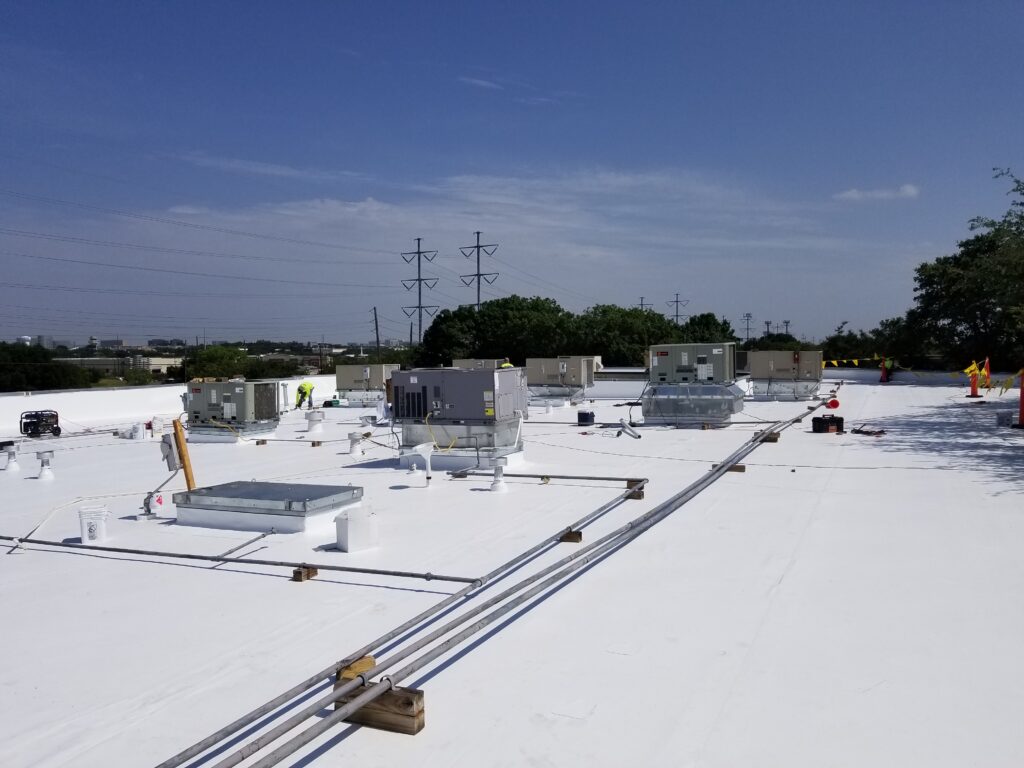
Thermoplastic polyolefin (TPO) became the dominant commercial single-ply membrane in Austin over the last two decades for a straightforward reason: a properly installed white TPO roof reflects 80–90% of incident solar radiation, which matters on a flat commercial roof in a city that regularly logs 90-plus days above 100°F ambient temperature. On a dark or aged membrane, surface temperature can exceed 165°F on a peak Austin summer afternoon. On a properly installed 60-mil white TPO, that surface temperature drops to the low 100s — a material reduction in cooling load for any building without heavy rooftop shade.
TPO is also heat-weldable at the seams, which produces mechanically superior lap joints compared to adhesive-bonded or tape-sealed membranes. When installed at correct weld temperatures and speeds — which vary by membrane brand and ambient temperature — a TPO seam is stronger than the base membrane. When installed incorrectly, the seams are the first failure point. We calibrate weld parameters to current ambient conditions, not to a fixed setting.
Austin's hail history matters for TPO membrane selection. The June 2024 storm dropped quarter-size hail across Round Rock and Pflugerville. The November 2022 storm affected north Travis County. We specify 80-mil TPO for buildings in hail-exposed locations or those with known limitations on maintenance access — the additional membrane thickness extends impact resistance meaningfully. For buildings with frequent foot-traffic or rooftop mechanical work, we add walk pads at access routes.
How We Install TPO on Austin Commercial Buildings
Substrate preparation: The existing deck — typically steel or concrete for commercial applications — gets inspected for fastener pullout resistance before we anchor the insulation. Steel decks corroded below structural spec get documented and flagged for the owner; we do not install over compromised deck.
Insulation: Polyiso board in a single or double layer depending on required R-value, mechanically fastened to deck at pattern density calculated for wind-uplift zone. A HD polyiso or gypsum cover board over the primary layer gives the TPO membrane a smooth substrate and reduces thermal bridging at fastener locations.
Membrane: 60-mil for standard commercial applications; 80-mil for hail-exposed or high-traffic roofs. Rolls are positioned with factory-selvedge edges aligned for overlap, then hot-air welded at 1.5-inch minimum weld width. Weld quality is verified by probe test every 100 linear feet and by tensile pull test on sample welds at start of each day and after any break in production. We do not field-test only; seam width and weld temperature are logged throughout.
Flashing: All penetrations, curbs, edges, and parapets get TPO-compatible flashing membrane, either pre-formed or cut from roll, welded to the field membrane. Parapet coping cap is aluminum or galvalume; exposed coping joints are sealed with compatible TPO sealant, not generic caulk.
TPO Warranty Paths on Austin Projects
Standard commercial TPO warranties run 10, 15, or 20 years from most major manufacturers. The 20-year NDL (no-dollar-limit) warranty covers material and labor cost to repair or replace any warranted failure — it is the benchmark for commercial property owners who want to transfer the roof liability to the manufacturer for the warranty period.
NDL warranty qualification requires the manufacturer's field inspector to walk the completed roof and sign off on details. Most national TPO manufacturers have regional reps covering Central Texas. We schedule the inspection as part of the closeout sequence — the warranty document does not issue until the field inspection passes.
Warranty maintenance is required by every major manufacturer to keep the warranty in force. Typically: one annual inspection by the contractor with a written condition report submitted to the manufacturer, caulk and sealant renewal at penetrations and terminations on the inspection schedule, and prompt repair of any membrane puncture or mechanical damage within the coverage period. We offer maintenance contracts structured to each manufacturer's requirement — not a generic annual visit.
TPO Recover vs. Full Replacement in Austin
If the existing roof system has dry insulation (confirmed by moisture core sampling) and a structurally sound deck, recovering over the existing system with new TPO can extend asset life 15 to 20 years at roughly half the cost of full replacement. The recover eliminates tear-off and disposal costs, which matter more on larger Austin roofs where disposal logistics (and the city's landfill tipping fees) add up.
We do not recover over wet insulation. Wet insulation trapped under a new membrane will continue to degrade the deck, void the new membrane warranty, and produce premature failure. If core sampling shows saturation above 25% of the sampled area, full replacement is the correct scope. Between 10% and 25% wet, we often do targeted insulation replacement in wet zones before recovering the rest.
Austin's limestone substrate can complicate drain relocation if a recover requires changing slope. We document existing drain locations and ponding patterns in the pre-scope walk and design the recover package around what the drain layout can support — not around a theoretical ideal slope.
How does Austin's heat affect TPO weld quality?
Heat-welding TPO in Austin's summer ambient temperatures (95–105°F) requires adjusting weld speed and air temperature settings relative to spring or fall installation. We calibrate daily at start of production and after any extended break. Crews do not run standard cool-weather settings in August — the substrate temperature affects how the membrane flows at the weld, and incorrect settings produce seams that probe-test clean but delaminate under thermal cycling.
Is 60-mil or 80-mil TPO better for Central Texas?
60-mil is standard for most Austin commercial applications. 80-mil is worth the additional cost per square for roofs in hail-exposed locations (north Travis County, Williamson County, and Pflugerville/Round Rock have documented hail frequency above the Austin MSA average), for roofs with regular foot traffic or mechanical maintenance access, or for buildings where management turnover makes maintenance consistency uncertain. The 20-mil difference in thickness adds meaningful impact resistance with no change in installation method.
Can TPO be installed over an existing EPDM or BUR roof?
In many cases, yes — subject to moisture core sampling confirming dry insulation and a structural review confirming the existing assembly can support the added dead load. The City of Austin Development Services Department requires a permit for recover projects above a certain scope threshold; we pull the permit as part of project set-up. The bigger constraint is often drain elevation: if the existing assembly is already at or near parapet height, an additional insulation-plus-membrane layer may exceed the drains, requiring drain riser modification.
Get a TPO scope for your Austin commercial building.
We will walk the roof, sample cores if the recover-vs-replace decision requires it, and provide a written specification you can use for comparison or direct award.
- Infrared Moisture Scanning
- Silicone Roof Coating
- School Roofing
- Hotel Roofing
- Drone Roof Inspection
- Roof Leak Repair
- Humidity Damage Roof Repair
- About
Leak points, drainage, seams, penetrations, edge metal, roof access, and interior risk should be clear before the next roof decision is priced.
Immediate repair, maintenance, coating, recover, and replacement choices should be measured against roof age, moisture risk, tenant disruption, and budget timing.
A site visit is useful when the owner needs a documented roof condition, active leak response, storm review, or a clearer capital plan.