
Drain Cleaning Repair in Austin, TX
- About
- Services
- All Services
- Built-Up Roofing Aust
- Commercial Roof Coatings Aust
- Commercial Roof Condition Reporting Aust
- Commercial Roof Inspections Aust
- Commercial Roof Leak Repair Aust
- Commercial Roof Maintenance Aust
- Commercial Roof Repair Aust
- Commercial Roof Replacement Aust
- Commercial Skylight Repair Aust
- EPDM Roofing Aust
- All Roof Systems
- Ballasted Roof Systems Aust
- Built-Up Roof (BUR) Systems Aust
- Cool Roof Systems Aust
- EPDM Roof Systems Aust
- Modified Bitumen Roof Systems Aust
- PVC Roof Systems Aust
- Silicone Roof Coating Systems Aust
- Spray Polyurethane Foam Roof Systems Aust
- Standing Seam Metal Roof Systems Aust
- TPO Roof Systems Aust
- All Industries
- EV Facility Roofing Aust
- Education Facility Roofing Aust
- Entertainment & Music Venue Roofing Aust
- Financial Services Roofing Aust
- Government Facility Roofing Aust
- Healthcare Roofing Aust
- Hospitality & Hotel Roofing Aust
- Logistics & Distribution Roofing Aust
- Semiconductor & Fab Roofing Aust
- Tech Campus Roofing Aust
- All Damage & Repair
- Fire Damage Roof Repair Aust
- Freeze Damage Roof Repair Aust
- Hail Damage Roof Repair Aust
- Insurance Claim Roof Documentation Aust
- Leak Damage Roof Repair Aust
- Storm Damage Roof Repair Aust
- Structural Roof Damage Assessment Aust
- Tornado Damage Roof Repair Aust
- Water Damage Roof Repair Aust
- Wind Damage Roof Repair Aust
- All Property Types
- Distribution Center Roofing Aust
- Manufacturing Facility Roofing Aust
- Medical Building Roofing Aust
- Multifamily Roofing Aust
- Office Building Roofing Aust
- Religious Building Roofing Aust
- Restaurant Roofing Aust
- Retail Roofing Aust
- School Roofing Aust
- Warehouse Roofing Aust
- All Capabilities
- Commercial Roof Condition Reports Aust
- Commercial Roof Inspections Aust
- Commercial Roof Moisture Surveys Aust
- Commercial Roof Zone Mapping Aust
- Competitive Bid Coordination
- Infrared Roof Scanning Aust
- Manufacturer Warranty Management
- Owner Rep Services — Commercial Roofing Aust
- Replacement vs. Recover Analysis Aust
- Roof Asset Management Aust
A blocked drain on an Austin commercial flat roof is not a maintenance inconvenience — it is a structural load event. We clean, repair, and replace commercial roof drain systems with the context of Central Texas storm intensity in mind.
Austin's documented storm history makes drain maintenance on commercial flat roofs more consequential here than in most markets. The Memorial Day 2015 floods dropped over 11 inches of rain in parts of the Austin metro in a matter of hours. The Halloween 2013 floods followed a similar pattern. The City of Austin's drainage infrastructure was overwhelmed; commercial roofs with blocked or undersized drain systems ponded to structural load thresholds. Water weighs 5.2 pounds per square foot per inch of depth — a 50,000 sq ft flat roof with 4 inches of ponded water is carrying 1.3 million additional pounds it was not designed to hold.
Commercial flat roof drain systems in Austin accumulate four primary debris types that reduce capacity. Live oak leaf litter — Austin's urban tree canopy is heavily live oak, and live oaks shed in spring rather than fall, which means the heaviest debris season coincides with Austin's storm season — accumulates in drain bowls and over drain screens faster than in markets with deciduous canopy. HVAC condensate mineral deposits build up around drain bowl rims and on strainer screens on roofs with rooftop mechanical equipment. Construction debris from adjacent development sites migrates onto existing roofs in the fast-developing North Austin, Mueller, and Southeast Austin corridors. Organic growth — moss and algae — colonizes drain areas in shaded roof zones.
We clean and maintain drain systems on a scheduled basis and respond to emergency drain issues when storm events produce ponding on commercial buildings. The difference between a routine maintenance call and a structural emergency is usually one blocked drain on a building with no overflow system.
Primary drain cleaning: We clear drain bowls and strainer screens of all accumulated debris, flush the drain line to verify flow, and inspect the drain clamping ring and membrane collar for separation. On roofs where the drain line discharges to a below-grade storm sewer — common on Austin commercial buildings in the CBD and the South Congress corridor, where surface drainage options are constrained — we confirm discharge connectivity and note any evidence of back-pressure from a below-grade blockage.
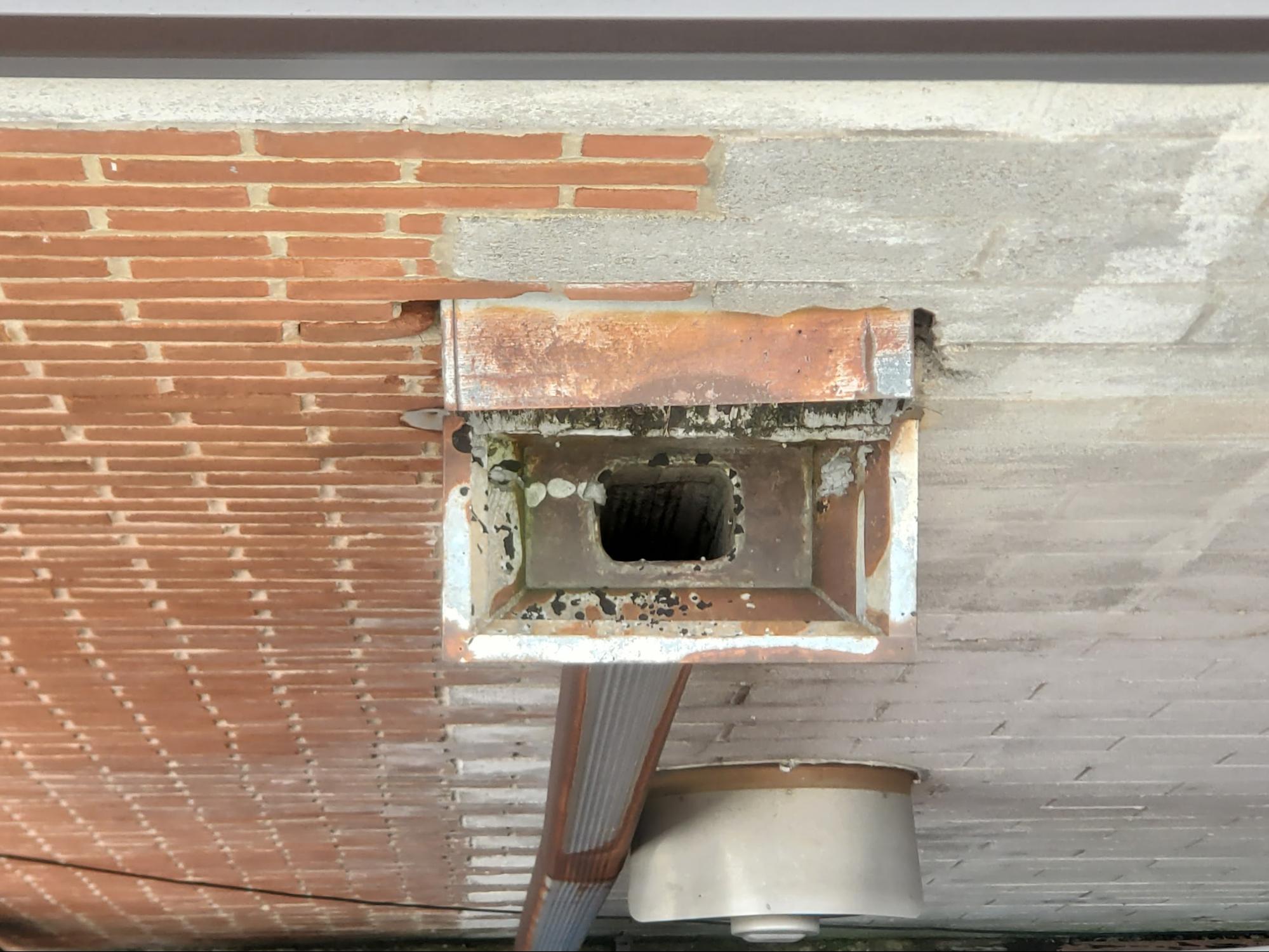
Scupper inspection and cleaning: Scuppers — through-wall drainage openings at parapet level — are the secondary drainage system on most Austin commercial buildings and the primary system on some. Scupper openings collect debris from the roof field and from the exterior wall surface below. Blocked scuppers on buildings with no interior drain redundancy are the most common cause of emergency ponding calls we receive after Austin storm events. We clear scupper openings and inspect the scupper throat and exterior discharge for debris and corrosion.
Overflow drain verification: Overflow drains and overflow scuppers are the last line of defense against structural ponding. Their inlet elevation is set above the primary drain inlet — they activate only when primary drainage is blocked. We verify that overflow inlets are clear and unobstructed and that overflow discharge paths are clear to daylight. Buildings in the Mueller district built under post-2010 Austin drainage code are more likely to have properly sized overflows; buildings predating the 2007 code updates sometimes have undersized or missing overflow systems.
Drain collar and membrane repair: The drain clamping ring compresses the field membrane against the drain body flange, creating a watertight joint. When the clamping ring screws corrode — a consistent finding on Austin commercial drains more than 15 years old — the compression fails and water migrates between the membrane and the drain body. We replace corroded clamping ring hardware, re-seat the membrane, and apply a compatible sealant at the collar joint.
Full drain replacement: When the drain body itself has corroded, cracked, or settled out of plane with the roof deck, full replacement is the scope. Drain replacement requires cutting the field membrane around the drain, removing the existing drain assembly, installing a new drain body with the correct outlet diameter for the drain line below, and re-terminating the field membrane to the new drain. We match the new drain body material (cast iron, PVC, or aluminum depending on the existing system and line pressure) to the drain line below and the membrane system above.
Drain relocation and slope correction: On buildings where existing drains are positioned in a location that promotes ponding rather than drainage — a pre-design error common on pre-1990 commercial construction in Austin — we assess whether targeted insulation tapered to a new drain location can correct the problem without full system replacement. Drain relocation on active buildings requires coordination with the drain line routing below the roof deck, which on multi-story buildings means coordination with the plumbing system.
Emergency Response After Austin Storm Events
After major Austin storm events — the pattern established by the 2013 and 2015 flood events and continued in subsequent seasons — we deploy to commercial buildings in the storm track to assess ponding and provide emergency drain clearing. Inner-city Austin buildings in the Rainey Street and East 6th corridors receive priority emergency response given their proximity to our Congress Avenue office.
Emergency drain clearing on an actively ponding roof is a priority-one call. We arrive with water-suction equipment if ponding volume requires it, clear the primary drain obstruction, verify overflow drain function, and assess any structural load concern based on ponding depth and roof structural rating. We document the emergency response with photos and a written incident report.
How often should commercial roof drains in Austin be cleaned?
Twice per year is the standard maintenance cadence for most Austin commercial buildings — once in late winter or early spring before live oak leaf-drop season, and once in late fall before the winter wet season. Buildings with heavy rooftop tree canopy coverage or adjacent to active construction sites may need quarterly cleaning. Buildings with rooftop HVAC equipment that deposits mineral buildup around drain collars should have drain collars inspected annually regardless of the cleaning schedule.
My roof is ponding after rain but eventually drains. Should I be concerned?
Yes. Building codes limit allowable ponding duration on commercial flat roofs — water that has not drained within 48 hours of the last rainfall is considered standing water and indicates inadequate slope or drainage capacity. Sustained ponding also accelerates membrane degradation and indicates the drain system is partially blocked even if it eventually clears. We can assess the drain capacity and slope pattern and determine whether the issue is blockage, undersized drains, or slope design.
Can a drain be added to an existing Austin commercial flat roof?
Adding a drain to an existing flat roof is feasible when the roof structure allows a new drain line to be run to the storm sewer below. The constraints are usually the drain line routing — on multi-story buildings in downtown Austin, routing a new drain line through occupied floors is a significant construction scope — and the slope of the existing roof field. If the existing roof slopes away from the proposed new drain location, tapered insulation is required to redirect water to the new drain. We assess drain addition feasibility during the scope walk.
Schedule drain cleaning or drain assessment for your Austin commercial building.
We clean, inspect, and repair commercial roof drain systems across Travis County. Emergency response available for active ponding situations.
- Office Building Roofing
- Commercial Reroofing
- TPO Roofing
- Roof Inspections
- Silicone Roof Coating
- Healthcare Facility Roofing
- Standing Seam Metal Roofing
- About
Leak points, drainage, seams, penetrations, edge metal, roof access, and interior risk should be clear before the next roof decision is priced.
Immediate repair, maintenance, coating, recover, and replacement choices should be measured against roof age, moisture risk, tenant disruption, and budget timing.
A site visit is useful when the owner needs a documented roof condition, active leak response, storm review, or a clearer capital plan.